
The Science, The Psychology & The Hidden Formula Nobody Tells You
Let’s begin with an uncomfortable truth.
Your resume is not being read.
It is being judged.
In less time than it takes to unlock a phone, a recruiter decides whether your career story deserves attention — or deletion. Research frequently shared on platforms like LinkedIn confirms that recruiters scan, not study.
So if you’re writing your resume like an essay…
You’ve already lost.
This article is not about “make it professional” advice. This is about engineering a resume so powerful, so precise, that it forces attention.
Welcome to resume strategy at a different level.
Why Most Resumes Fail (Even If You’re Talented)
Here’s the brutal reality.
People focus on:
- Fonts
- Templates
- Fancy designs
- Long summaries
Recruiters focus on:
- Relevance
- Results
- Risk reduction
- Clarity
Your resume is not art.
It’s strategy.
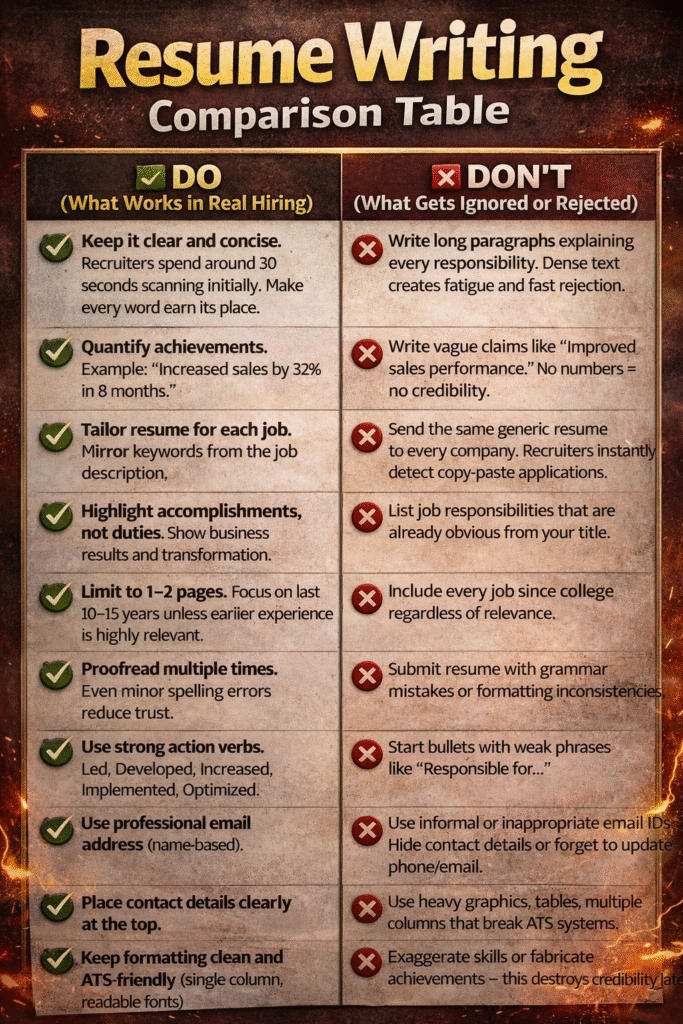
Why These Do’s & Don’ts Matter Psychologically
Hiring decisions are about risk.
Every mistake in your resume increases perceived risk:
- Spelling errors = carelessness
- Vague statements = lack of impact
- Inconsistent formatting = lack of structure
- Exaggeration = credibility risk
On the other hand:
- Clear numbers = confidence
- Structured layout = professionalism
- Tailored content = seriousness
- Concise writing = clarity of thought
Recruiters subconsciously reward low-risk candidates.
Your resume must reduce doubt.
Why Everyone Is Still Making the Same Mistake
Most candidates write resumes emotionally.
They write what they did.
Recruiters evaluate resumes logically.
They look for:
- Keywords
- Clarity
- Metrics
- Alignment with job description
Just like search engines such as Google scan for relevant keywords, recruiters scan for relevant skill signals.
If your resume doesn’t mirror the language of the job description, it becomes invisible — especially to ATS (Applicant Tracking Systems).
The Practical Structure That Wins Attention
Let’s engineer your resume strategically.
1. Replace the “Objective” With a Positioning Headline
Instead of:
Seeking a challenging opportunity…
Write:
Procurement & Supply Chain Specialist | 6+ Years Driving Cost Optimization & Vendor Performance
Immediately clear. Immediately relevant.
2. Create a Skill Power Block at the Top
Place this right under your headline:
CORE EXPERTISE • Vendor Negotiation • Data Analysis • Cost Reduction Strategy • Process Optimization • SAP / ERP Systems
This makes your resume ATS-friendly and recruiter-friendly.
3. Write Impact-Based Bullet Points
Use this proven formula:
Action Verb + What You Did + Measurable Result + Business Benefit
Example:
Negotiated long-term supplier contracts, reducing procurement costs by 21% while improving delivery compliance by 15%.
That single line speaks louder than five lines of responsibilities.
The Curiosity Trigger Technique
Your resume should not explain everything.
It should spark interest.
Instead of writing a full case study, write:
Spearheaded cross-functional restructuring initiative that increased department efficiency by 42% within 8 months.
Let the recruiter ask “How?” in the interview.
A resume that creates curiosity gets callbacks.
Design Psychology: Make It Easy to Say Yes
Recruiters reject resumes faster when reading feels difficult.
So apply these technical rules:
- 11–12 point font
- One-column layout
- 0.8–1 inch margins
- Clear section headings
- Bullet points (not paragraphs)
- Plenty of white space
White space improves readability. Readability improves retention. Retention improves interview chances.
Resume + LinkedIn Alignment = Trust
Recruiters almost always cross-check with LinkedIn.
If your job titles, dates, or achievements differ — it creates doubt.
Ensure:
- Same timeline
- Same key accomplishments
- Same career positioning
Consistency builds credibility.
Credibility builds confidence in hiring you.
The “Less But Powerful” Principle
Your resume is not your biography.
If a job from 12 years ago doesn’t support your current target role — remove it.
Relevance beats volume.
Clarity beats clutter.
Impact beats information overload.
The Ultimate Mindset Shift
Stop asking:
How do I describe what I did?
Start asking:
How do I prove the impact I created?
Because modern resumes are not about tasks.
They are about transformation.
They are about the measurable difference you made.
They are about positioning yourself as a solution — not just a candidate.
Final Thought: Make Them Pause
In a world where hundreds apply, only a few stand out.
The resumes that win:
✔ Speak in results
✔ Show measurable and qualitative impact
✔ Align with recruiter psychology
✔ Use clean formatting
✔ Trigger curiosity
When crafted strategically, your resume doesn’t beg for attention.
It commands it.
And in those few seconds that decide your future — That difference means everything.
