
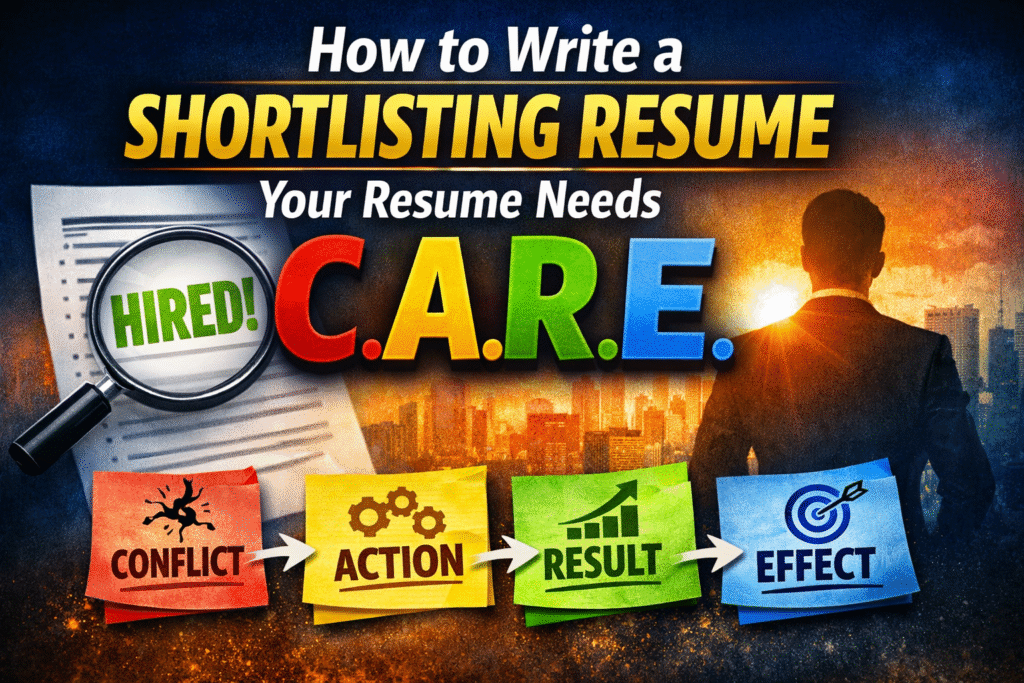
Your Resume Is Not Paper.
It Is Pressure. It Is Proof. It Is Power.
Somewhere right now, a recruiter is opening a resume.
They don’t know you.
They don’t know your struggle.
They don’t know the late nights, the targets, the risks you took.
They only see words.
And those words must carry weight.
Because in less than a minute, they will decide something that could change your life.
The question is not: Are you talented?
The question is: Does your resume make them feel it?
Most Resumes Feel Safe.
And Safe Is Invisible.
They say:
- Responsible for operations
- Managed a team
- Worked on projects
- Assisted with clients
These sentences are not wrong.
They are just lifeless.
They don’t show tension.
They don’t show challenge.
They don’t show movement.
And without movement, there is no story.
Without story, there is no curiosity.
The Technique You’ve Been Missing
If your resume feels flat, it’s because it lacks structure.
Not decoration.
Not longer paragraphs.
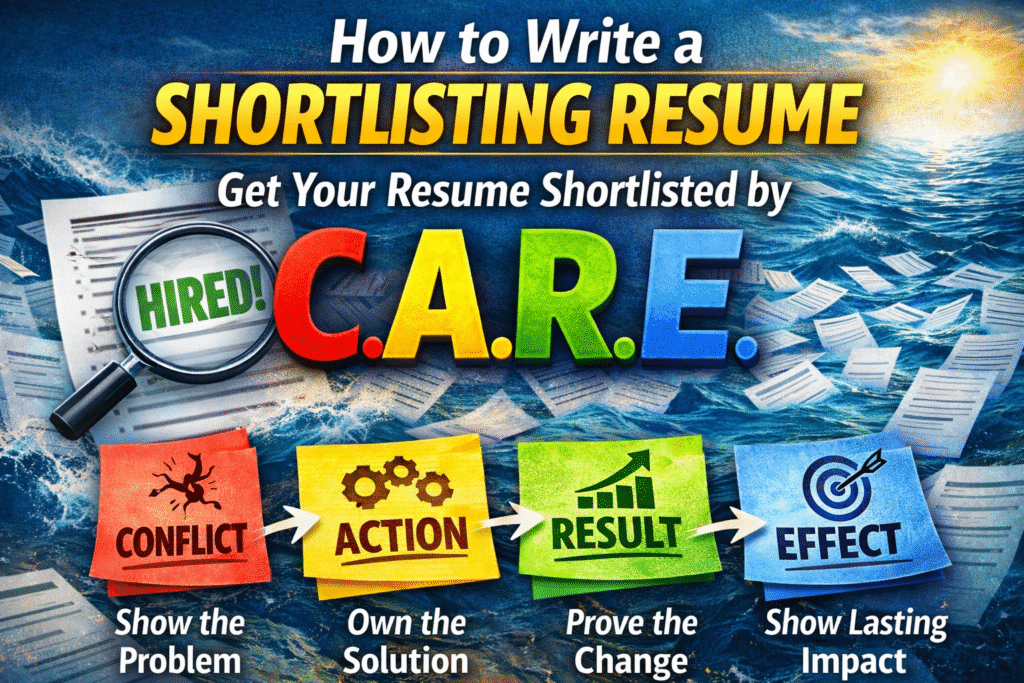
How to Write a Shortlisting Resume
Your Resume Needs C.A.R.E.
There are two kinds of resumes in this world.
One gets opened… scanned… and forgotten.
The other gets shortlisted.
The difference is not luck.
It is not design.
It is not even experience.
It is structure.
If you want a resume that gets shortlisted — not ignored — you must remember one powerful word:
C.A.R.E.
Because your resume doesn’t just need content.
Your resume needs CARE.
C — Conflict
Show the Problem Before You Show Yourself
Every company hires for one reason:
Something needs improvement.
Revenue needs growth.
Processes need fixing.
Customers need retention.
Systems need structure.
If your resume only says what you “handled” or were “responsible for,” it sounds passive.
Instead, reveal the challenge you stepped into.
Instead of:
Managed inventory operations.
Write:
Faced with rising stock discrepancies and delayed reporting across multiple departments…
Now the recruiter feels tension.
Now there is curiosity.
Now there is a reason for your existence in that role.
Conflict creates attention.
And attention creates shortlisting.
A — Action
Show Ownership, Not Participation
This is where most resumes lose power.
Words like:
- Helped
- Assisted
- Worked on
They shrink your authority.
Shortlisting resumes use strong ownership language:
- Designed
- Implemented
- Led
- Rebuilt
- Negotiated
- Optimized
- Spearheaded
Example:
Redesigned the inventory tracking system and introduced real-time reporting tools.
Now you are not part of the system.
You improved it.
Recruiters shortlist decision-makers, not bystanders.
R — Result
Prove That Something Changed
Effort is invisible.
Results are unforgettable.
Ask yourself:
What improved because of me?
- Did time reduce?
- Did revenue increase?
- Did productivity rise?
- Did costs drop?
- Did engagement grow?
Example:
Reduced stock discrepancies by 35% and accelerated reporting accuracy within 60 days.
Now your statement has weight.
Numbers turn claims into credibility.
And credibility builds trust — fast.
E — Effect
Show the Long-Term Impact
This is where your resume moves from impressive to powerful.
Did your work:
- Become a permanent system?
- Get adopted company-wide?
- Influence future strategy?
- Improve team morale?
- Strengthen brand reputation?
Example:
The system was adopted across regional branches and remains the standard reporting model today.
Now your impact feels lasting.
Not temporary.
Not accidental.
But meaningful.
Why C.A.R.E. Gets You Shortlisted
Because recruiters don’t just want to know what you did.
They want to know:
- Did you solve something?
- Did you take ownership?
- Did you create measurable improvement?
- Did your contribution last?
When your resume follows C.A.R.E., every bullet becomes a mini success story.
And mini success stories create major curiosity.
The Deep Reality
A shortlisting resume does not scream.
It does not exaggerate.
It quietly demonstrates value.
It shows conflict.
It shows courage.
It shows competence.
It shows change.
And when a recruiter reads it, they don’t think:
“This person did their job.”
They think:
“This person makes things better.”
That thought is what moves your resume
from inbox
to shortlist
to interview.
Final Reminder
Your resume is not a biography.
It is a business case for hiring you.
So before you send it, ask yourself:
Does it show C.A.R.E.?
Because in a competitive world,
talent gets noticed…
But structured, powerful storytelling
gets shortlisted.
